The world offers more than examples to learn from. It also offers structure. An object can turn while keeping its identity. A physical system changes according to relationships that persist across observations. Scientific understanding grows by finding these relationships and expressing them in a form that carries from one situation to another.
We ask how those same principles can become part of the way an AI model learns. A model’s internal representation determines which relationships are easy to express, which changes it can follow, and what it may carry into an unfamiliar setting. Our aim is to build representations whose organization reflects meaningful structure in the world, making learning more interpretable, more efficient with data, and more capable of generalization.
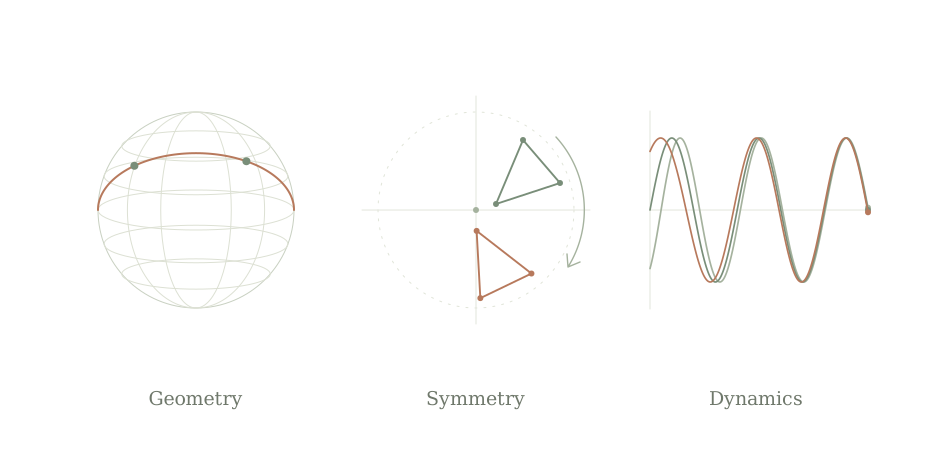
Geometry gives us one starting point. Different kinds of information belong to different spaces: a direction lives on a sphere, and a family of transformations has relationships that an ordinary list of coordinates can hide. We study how the geometry of a representation can preserve these relationships, and how learning and computation should work within such spaces.
Symmetry concerns how things change together. When an object rotates, we may want its identity to remain stable while its orientation changes in a predictable way. A useful representation should make these different aspects accessible. We investigate how transformations can be built into models or learned from data, so that the relationships among observations help organize what a model learns.
Dynamics brings time and interaction into this picture. A representation can evolve through the motion of a state or through many states influencing one another. Oscillation and synchronization suggest ways to organize that evolution. Our work explores how these principles can shape neural computation, from interactions in attention to the way recurrent models carry information through a sequence. They provide both mechanisms to design with and questions to test in trained systems.
These perspectives meet in structured representation learning. We want to understand which scientific principles can become useful constraints on learning, how those constraints can be expressed in a model, and when a model should discover the structure for itself. The ambition is to develop methods that travel across problems, with a clear account of why a particular structure helps and where its assumptions stop being useful.
The relationship with science runs in both directions. Geometry, physics, and neuroscience can inform the design of AI. In turn, models built around those principles may help us investigate scientific systems: following motion across timescales, recovering hidden causes from observations, or generating objects that respect the structure of their domain. We see model design and scientific understanding as parts of the same continuing exchange.
Over the longer term, we hope to make scientific structure a practical foundation for building AI. That means moving between mathematical ideas, working architectures, and evidence from real problems. Each model gives us a way to test a principle; each result helps us decide what to preserve, what to learn, and what to rethink. The goal is to build systems whose ability to learn is strengthened by an understanding of the world they encounter.